
Is it powering off usually in the middle of the night? Does it trip again immediately after you reset it? These two situations point to different faults. If you’re confused now, “Why does my RCD keep tripping?”, the tripping time, the weather, and which circuits are protected by the RCD usually explain most of the problem. This guide will break this down step by step.
What Makes an RCD Trip, and Why 15 mA Can Be Enough
In November 2024, the IEC released the product standard for RCCBs. This standard retains the basic rules for 30 mA devices: when the residual current is below 15 mA, the RCD must remain closed; when it reaches 30 mA, it must trip within 300 ms; and when it reaches 150 mA, it must trip within 40 ms. The 15-30 mA range is the allowable tripping range.
An RCD continuously compares the current flowing in the line conductor with the current returning through the neutral conductor. When the two are equal, the RCD will not trip. When part of the current returns through earth – for example, through a damp cable, a cracked electric heating element, or a person’s body – the resulting imbalance is detected by the sensing coil, and the RCD disconnects the circuit.
Because the actual tripping threshold may fall anywhere between 15 and 30 mA, two functioning RCDs from the same batch may behave differently on the same circuit. One may remain closed with 20 mA of background leakage, while the other trips. This explains a situation often discussed on forums: a user replaces the RCD, the tripping stops for a month, and then returns.
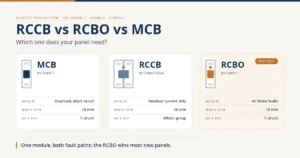
First, we need to clear up a common misunderstanding. A standalone RCD is sold as an RCCB and doesn’t have overload or short-circuit protection, so switching on too many heaters at once will not cause it to trip. If the adjacent MCB trips at the same time, or the device is a combined unit, then there is another issue – overcurrent. This comparison of RCCB, RCBO, and MCB functions shows which device responds to which type of fault.
Why Does My RCD Keep Tripping? 7 Common Reasons
In 2026, the Electrical Regulatory Commission (ERAC) reported that since 2000 there had been 306 electric-shock deaths involving user-side appliances and equipment in Australia and New Zealand – almost twice the 161 incidents linked to grid assets. RCDs are intended to protect household circuits and equipment, so most trips involve appliances and household wiring.
1. A Leaking Appliance
The common ones are electric kettle, washing machine, oven and immersion heater. The electric heating elements of these devices are filled with a magnesium oxide insulation layer, which will absorb water over time. Once damp, the electric heating element will leak current to the grounded metal shell, and often only occurs during heating. If the trip occurs just after using the washing machine or boiling water, please check the corresponding electrical appliances first.
2. Water in an Outdoor Socket or Light
If the trip always occurs at the same time as raining, frosting or flushing the terrace, check the outdoor section. Cracked waterproof covers, failed seals for garden lights and extension cords placed on damp grass create current paths to the ground. Bathroom exhaust fan or attic junction box damp, will also cause the same results.
3. A Neutral-to-Earth Fault on Any Circuit
This is the hardest cause to understand. If the neutral conductor on one circuit comes into contact with earth, some of the return current from other circuits on the same RCD may flow back through the earth. As a result, even if the fault is actually in a bedroom socket, switching on the kettle in the kitchen may cause the RCD to trip.
4. Cumulative Leakage From Healthy Equipment
LED drivers, computers, televisions, and all devices with power filters are designed to leak a small, permissible amount of current to earth. The leakage from each device is well below any limit. However, when a home office and audiovisual equipment are connected to the same RCD, the total leakage may exceed 15 mA, so the RCD may trip even though no equipment has failed.
5. Old or Damaged Cable Insulation
Rubber-insulated cables in older homes age and break down over time.New cables may also be damaged, such as screws into the wall, nails under the floor or rat bites in the attic. Such faults usually develop gradually, so trips will become more and more frequent in a few weeks.
6. Surges and Switching Transients
Nearby lightning strikes, grid switching and large motor start-up will generate a transient current through the distributed capacitance of the cable and filter. RCD trips once after detecting a short-term imbalance, and then it can usually be reset normally. If frequent trips occur in thunderstorm days, it indicates that the distribution box needs surge protection; This surge protective device (SPD) installation guide has detailed instructions.
7. A Worn RCD or the Wrong RCD Type
The mechanical parts of an RCD wear over time, and the detection circuit can drift, so an old RCD may become too sensitive. Type is also important. Type AC devices are designed only for pure sinusoidal AC residual current; under AS/NZS 3000, Australia has prohibited their use in new installations since 1 May 2023. The analysis of the Type AC pitfall in this RCBO buying guide explains the reason for this prohibition.
How to Find Out What Is Tripping Your RCD?
The British electrical installation specification BS 7671:2018+A4:2026 issued in April 2026 stipulates that the minimum insulation resistance of the 230 V circuit at 500 V DC test voltage is 1 MΩ. This test is completed by the electrician and is the last step in the investigation. Before this, use the timing of the trips as a clue and disconnect circuits one at a time; this usually narrows the fault down to a particular circuit.
The table below maps the most common faults to possible causes.
| Fault | Likely cause | Next step |
|---|---|---|
| Trips the moment you reset, nothing plugged in | Fixed wiring fault, neutral-to-earth fault or failed RCD | Stop resetting and call an electrician |
| Trips when one appliance heats up | Element insulation breakdown | Move the appliance to another socket and retest |
| Trips after rain or frost | Outdoor socket, light or garden cable | Isolate outdoor circuits and inspect seals |
| Trips at night or early morning | Timed loads: freezer defrost, immersion heater, heat pump | Check what runs on a timer |
| Trips at random with no pattern | Cumulative leakage or an intermittent fault | Split loads across circuits |
| Trips when a load on another circuit starts | Neutral-to-earth fault | Electrician with an insulation tester |
| Test button does not trip it | RCD mechanism failed | Replace the RCD |
Next, do a test by process of elimination. Pull out the electrical appliances on all sockets within the RCD protection range, disconnect all MCBs under the RCD, and then reset the RCD. Then close the MCB one by one. The one that makes the RCD trip is the suspicious circuit, keep it disconnected, and then plug the electrical appliances one by one back to test.
It should be noted that most household MCBs are unipolar, only disconnect the phase line, and the neutral line remains connected. If the RCD still trips after all MCBs are disconnected, it is likely to be a neutral line-to-ground fault, or the RCD itself is damaged. At this step, the circuit breaker troubleshooting is no longer suitable for their own hands.
Safety tips: If the RCD trips again immediately after reset, do not repeatedly force closing. A device that causes tripping as soon as it is reset indicates that there is indeed a fault at present, and only certified electricians should troubleshoot it.
How to Stop Your RCD or Safety Switch From Tripping for Good?
BS 7671 Article 531.3.2 requires the designer to control the current of the protective conductor downstream of the RCD below 30% of its rated residual operating current. For 30 mA devices, this limit is only 9 mA. Where a single RCD protects eight circuits with a large number of electronic devices, the 9 mA allowance may be used up before any actual fault occurs.
First, repair the real fault found in the above steps. Replace leaked electrical appliances, re-seal outdoor accessories, and repair damaged cables. Only after eliminating the real fault, can it be called nuisance tripping. In Australia, the safety switch on household sockets and lighting circuits must be kept at 30 mA.
Second, distribute the leakage current across different circuits. Because each RCBO monitors only its own circuit, each circuit gets its own 9 mA allowance rather than sharing a single one. A single-module, 18 mm Type A RCBO with a 10 kA breaking capacity is the same width as an MCB, so most consumer units can be upgraded one circuit at a time.
If fitting RCBOs throughout the consumer unit is unrealistic, the circuits can be split across two or three RCCBs. RCCBs are available in Type A, Type F and Type B, allowing each group to match its loads. Type F is suitable for heat pumps and inverter-driven washing machines, while EV chargers that can produce smooth DC leakage require a Type B RCCB capable of detecting DC fault current.
Finally, never replace the device with one that has a higher mA rating, never tape the switch in the closed position, and never short it out. In just 2024-2025, ERAC recorded four fatal incidents involving user-side electrical installations or appliances. If an upstream RCD is needed, use a Type S time-delayed device whose rated residual operating current is at least three times that of the downstream device, to ensure that the correct device trips first.
Conclusion: Why Does My RCD Keep Tripping?
RCD always trips, usually indicating that there is a fault. Leakage of electrical appliances, outdoor water, neutral line to ground failure, or simple cumulative leakage, can explain most of the situation; The action range of 15 to 30 mA explains why the trip appears to be irregular. First use the time clue and exclusion test to find out the fault, and then solve it from the design: Using RCBO or smaller RCCB grouping, each loop has an independent 9 mA limit.
FAQ
Why does my RCD trip at night?
Night-time tripping is usually related to loads that start automatically. Freezer defrost heaters, water heaters, and heat pumps running during off-peak electricity periods all start without anyone operating them. Since a 30 mA RCD may trip from as little as 15 mA, an aging heating element that starts at 2 a.m. can push the existing background leakage over the limit.
Why does the RCD trip but not the MCB?
They detect different faults. An MCB responds to overcurrent, and a Type B MCB only trips instantaneously at 3-5 times its rated current. RCD does not act according to the size of the load, only acts on the unbalanced current between the phase line and the neutral line, and may act as low as 15 to 30 mA. Only RCD tripped, indicating that it was a ground leak, not an overload.
Can an RCD become faulty or too sensitive?
Yes. The detection circuit can drift and the mechanism can wear, so an old RCD may trip below its rated value – or may not trip at all. Press the test button at least every six months, as recommended on the label on the consumer unit. If the button does not respond, or still trips after troubleshooting, please replace the device.
Why does my safety switch keep tripping in the rain?
After the rainwater enters, it will form a passage to the ground. Common locations include outdoor sockets, garden lights, external wall junction boxes, or cables under loose roof tiles. Without a lot of rain, a few drops of water connection terminals may leak 15 mA, which is enough to trip the 30 mA safety switch. Please disconnect the outdoor circuit and check every seal.
How do I stop nuisance RCD tripping?
First eliminate the actual fault, then reduce cumulative leakage. BS 7671 Regulation 531.3.2 aims to keep continuous leakage below 30% of the rated residual operating current – that is, 9 mA for 30 mA devices. Split the circuits onto individual RCBOs so that each circuit has its own allowance, and normal leakage from electronic equipment will not accumulate on the same RCD.