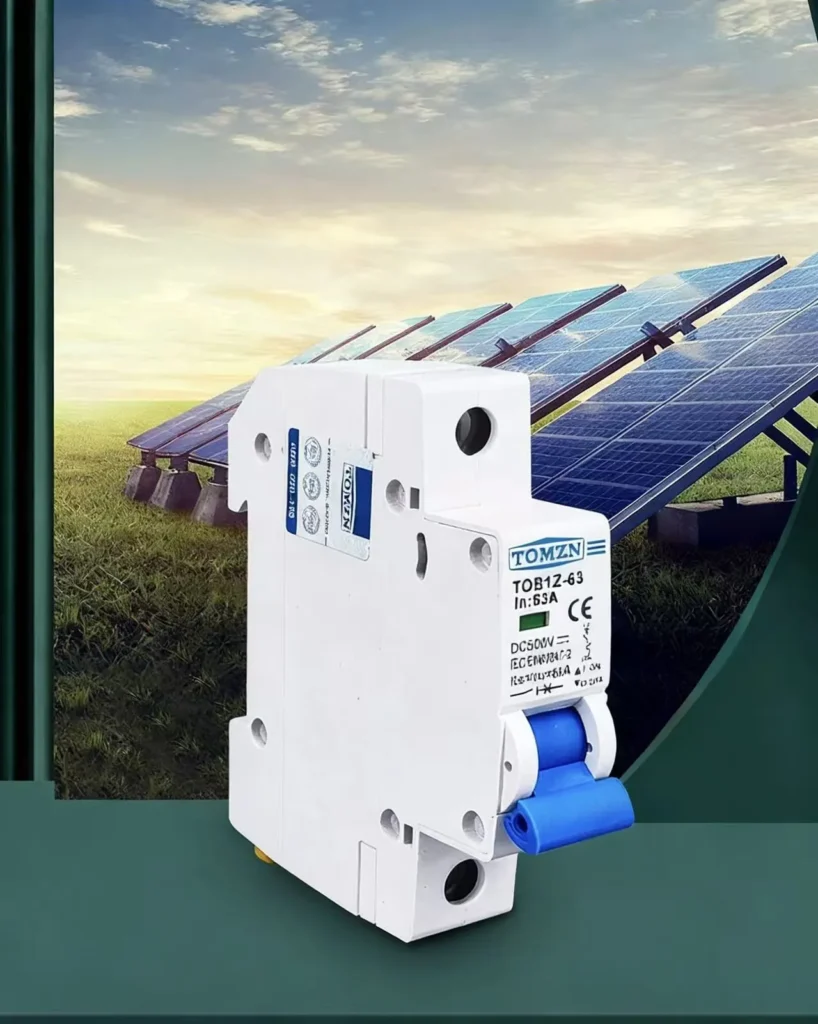
A DC circuit breaker plays an important role in modern power systems. With the rapid development of renewable energy, energy storage and electric transportation, the DC power grids are becoming more and more important that make DC circuit breakers a key piece of equipment for building safe, reliable and efficient modern power systems.
How does a DC circuit breaker work?
A DC circuit breaker identifies abnormal currents through internal thermal or magnetic tripping devices. When the current continuously exceeds a set value, the thermal tripping device activates and disconnects the circuit; when a short circuit occurs and the instantaneous current rises sharply, the magnetic tripping device quickly disconnects the circuit. Because DC current has no zero point, it is prone to arcing upon disconnection.
Therefore, circuit breakers for dc voltage are usually equipped with an independent arc-extinguishing structure to quickly elongate and extinguish the arc that ensures a safe and reliable circuit-breaking process.
Key Components and Internal Structure
I. External Structure
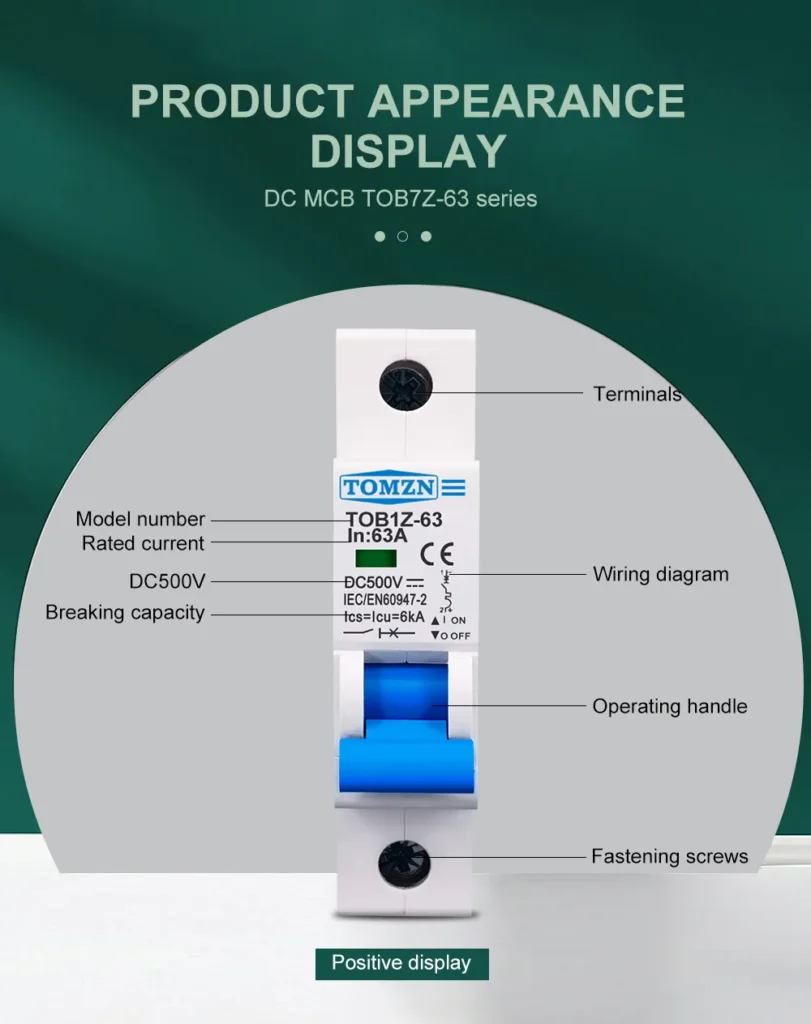
The external structure mainly involves safety, installation and the operating interface.
- Enclosure: Provides insulation, protection and mechanical support.
It prevents electric shock and protects internal mechanisms from dust, moisture and physical impact. And it is usually made of high-strength, high-temperature resistant engineering plastics (such as polyamide) or thermosetting materials (such as DMC).
- Operating Handle/Button: Used for manual “ON,” “OFF,” and “RESET” operations. The handle is usually in an intermediate position after tripping; it needs to be switched to “OFF” and then “ON” to reset.
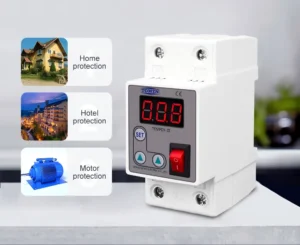
- Terminal Blocks: Connect external cables. They have “Power In” and “Load Out” terminals, clearly marked with positive (+)/negative (-) symbols and some may use color coding. And they can be screw-mounted, plug-in type or busbar connection type for high current.
- Mounting Mechanism: Secures the circuit breaker to the distribution cabinet (distribution panel). It is most commonly DIN rail mounted (such as a 35mm DIN rail conforming to DIN standards) for quick installation and removal. Bolt-mounted types are also available.
- Status Indicator Window: Indicates whether the current contact position is “closed” or “open” via color (red/green) or symbols.
- Nameplate: Indicates key electrical parameters such as rated voltage (Ue), rated current (In), breaking capacity (Icu), number of poles, applicable standards, etc.
II. Internal Structure
The internal structure contains all the precision components that enable connection, disconnection and protection.
Contact System: The core component for connecting and disconnecting current.
Active/Stationary Contacts: Carry the normal rated current.
It is specifically designed to withstand arc erosion when interrupting large currents (especially short-circuit currents) that protect the main contacts. and made of arc-resistant materials (such as tungsten-copper alloy).
The arcing contact makes contact first during closing; the arcing contact separates last during opening.
Arc Extinguishing System: This is the most critical and technologically advanced part of the DC circuit breaker that used to quickly extinguish DC arcs.
Arch-Extinguishing Grids: Composed of a series of mutually insulated metal grids. Under the influence of the magnetic field, the electric arc is driven into the grid plates and divided into a series of short arcs connected in series. Each short arc has its own cathode and anode voltage drop. When the sum of the voltage drops of all short arcs exceeds the power supply voltage, the arc cannot be sustained and extinguished.
Magnetic blow-out coil: Generates a strong magnetic field (related to the current direction). This magnetic field interacts with the arc current that generates a Lorentz force that rapidly elongates the arc between the contacts and blows it into the arc-extinguishing chamber. That is a hallmark design feature that distinguishes DC circuit breakers from AC circuit breakers.
Operating mechanism: Enables rapid closing and opening of the contacts, possessing a “fast closing and fast opening” characteristic, independent of the speed of the operating handle.
It employs a four-bar linkage mechanism that uses spring energy storage. When the handle is operated, the spring is compressed and stores energy. After exceeding a certain critical point, the spring energy is released instantaneously that drives the contacts to move rapidly and ensure extremely fast closing/opening speeds regardless of how slow the manual operation.
Tripping Mechanism: Detects fault current (overload or short circuit) and triggers the operating mechanism to achieve automatic tripping.
Common combinations of thermal-magnetic trip units include thermal trip elements, magnetic trip elements and electronic trip units.
- Thermal Tripping Element (Bimetallic Strip): Used for overload protection. When the current exceeds the rated value for an extended period, the bimetallic strip heats up and bends. It pushes the trip lever after delay that causes the mechanism to trip and has an inverse-time characteristic (the larger the current, the shorter the operating time).
- Magnetic Tripping Element (Solenoid): Used for short-circuit protection. When the current instantaneously reaches the short-circuit threshold (typically 5-10 times the rated current or even higher), the coil generates a sufficiently strong magnetic field that attracts the armature and instantly strikes the trip lever to make rapid tripping.
- Electronic Tripping Unit: Used in more advanced circuit breakers. Current is detected by a current transformer and the data is analyzed and judged by a microprocessor (MCU) that allow for more precise protection characteristics and parameter settings.
Internal Space: Provides sufficient space for arc expansion and cooling, guides the safe escape of arc gases and prevents short circuits between internal components.
Types of DC Power Circuit Breakers
| Classification | Type | Features |
| By technical principles | Thermal-magnetic DC circuit breaker | It offers comprehensive protection (overload + short circuit) and has low cost, mature technology and wide application. |
| Electromagnetic DC circuit breaker | It mainly relies on electromagnetic tripping mechanisms for protection and usually only has short-circuit protection function or extremely fast full-range breaking capacity. | |
| Solid-state DC circuit breakers | It uses power semiconductors (such as IGBTs) as switching elements that eliminate mechanical contacts and electric arcs. | |
| Hybrid DC circuit breaker | It combines the advantages of mechanical switches (low loss) and solid-state switches (fast breaking) for high-end applications. | |
| By application scenario | High voltage DC circuit breaker | It is designed specifically for high-voltage direct current transmission (HVDC) and large-scale energy storage systems and has the highest technological content that often employ hybrid or artificial zero-crossing technology. |
| Photovoltaic/Energy Storage/Electric Vehicle Dedicated | It is optimized for voltage and arc characteristics for specific applications such as the DC side of photovoltaic systems, battery packs and charging piles. |
What are the advantages of a DC Voltage circuit breaker?
1. Reusable: Manually reset after fault clearing, no replacement required and low maintenance cost.
2. Reliable Protection: Integrated overload and short-circuit protection, fast response speed.
3. High Adaptability: Can be designed for various DC systems from low voltage to ultra-high voltage, small current to large current.
What are the disadvantages of a DC circuit breaker?
1. High Initial Cost: Purchase cost is usually higher than disposable fuses.
2. Arc Extinguishing Challenge: DC arcs do not have a natural zero-crossing point, which places high demands on arc extinguishing design and materials, resulting in relatively large dimensions.
3. Complex Selection: Requires strict selection based on system voltage, current, breaking capacity, and other parameters that demand high professional expertise.
Applications in Modern Power Systems
1. Photovoltaic Power Generation System
In solar power plants, DC circuit breakers for solar need to be able to interrupt high DC voltages (typically up to 1000V or 1500V) and have sufficient arc-extinguishing capability. They prevent DC-side short circuits and overloads caused by photovoltaic panel failures (such as hot spot effects), line insulation damage and internal inverter faults. They also provide safe electrical isolation during system maintenance or repair that ensure operator safety.
- At the end of the string: Protect each string of solar panels that are easy to maintain and isolate.
- In the combiner box: Combine currents from multiple strings and provide overall protection.
- Inverter DC input: Serve as the main DC switch and protection for the inverter.
2. Battery Energy Storage System
In battery energy storage systems, DC circuit breakers require extremely high reliability and rapid breaking capacity. They prevent extreme faults such as internal battery short circuits and external connection short circuits that avoid battery thermal runaway and fires. And they also manage charging and discharging currents to prevent overload damage to the batteries.
- Inside the battery module/pack: Provides internal overcurrent protection.
- At the battery cluster outlet: Protects the entire battery cluster.
On the DC side of the energy storage converter: Acts as the main switch and protection between the battery system and the converter.
3. Electric Vehicles and Charging Infrastructure
Electric vehicles are inherently high-voltage DC systems and their charging also relies on high-power DC. Therefore a DC circuit breaker with extremely high safety standards and fast response (especially for in-vehicle protection) is required.
- In the in-vehicle high-voltage electrical system: Located at the battery pack outlet, it acts as the main protection switch for the vehicle’s high voltage (the main DC contactor is usually paired with a fuse, but advanced systems use solid-state or hybrid circuit breakers).
- Inside the DC fast charging station: Inside the charging station, protects the power module and output lines. Prevents short circuits caused by vehicle interface failures, cable damage, etc., during charging.
- Inside the vehicle: Quickly cuts off high-voltage power in the event of a collision or serious malfunction to prevent electric shock and fire.
4. Rail Transit and Shipbuilding
Subways, light rail, electric trains and modern ships widely employ DC traction and power distribution systems that require highly reliable DC circuit breakers capable of withstanding frequent starts&stops and vibration shocks. These circuit breakers ensure the continuity and stability of traction power supply and protect expensive traction converters and motors.
- In traction power supply systems: Protection of DC traction substations and overhead contact lines/third rails.
- In onboard power systems: Protection of DC auxiliary power supplies and equipment on trains or ships.
5. High-Voltage DC Transmission
HVDC is a core technology for achieving long-distance, high-capacity power transmission and asynchronous grid interconnection. HVDC circuit breaker technology is extremely complex that requires extremely high breaking speed, breaking capacity and reliability. Currently a hybrid technology approach is mainly adopted. It can achieve selective protection, similar to circuit breakers in AC power grids that are capable of rapidly (within milliseconds) interrupting DC fault currents of up to thousands of amperes.
At nodes in the DC grid: Used to isolate faulty lines that prevent local faults from causing the entire DC grid to collapse.
6. Industry and Data Centers
Many industrial processes (such as electrolysis and electroplating) and modern data center power supply architectures are shifting to DC power distribution.
It is primarily used in industrial DC distribution cabinets and data center DC backup power (battery) systems that protect industrial DC equipment and continuity of power supply to critical loads in data centers.
Safety Precautions
Can I use a DC circuit breaking for AC? The answer is no. Do not substitute ordinary AC circuit breakers for DC circuit breakers. Please also pay attention:
Voltage Rating: The rated voltage of the circuit breaker must not be lower than the maximum operating voltage of the system. DC voltage is more prone to arcing and voltage mismatch is extremely dangerous.
Current Capacity: The rated current should be greater than or equal to the normal operating current of the circuit with a certain margin. The protection characteristic curve of the circuit breaker should also be consulted.
Breaking Capacity: This is one of the most critical parameters. The ultimate breaking capacity of the circuit breaker must be ensured to be higher than the maximum expected short-circuit current that may occur at the installation point. Otherwise, an explosion may occur during a short circuit.
Correct Polarity: For circuit breakers with polarity requirements, the positive and negative terminals must be strictly distinguished during wiring. Reversing the connection will lead to protection failure or equipment damage.
Summary of Tips:
Selection and Installation: Correct selection is a prerequisite. Ensure the circuit is DC-specific; parameters are matched and breaking capacity is sufficient.
Operation and Run: Standardized procedures are key. Do not operate improperly. After a fault, investigate the cause before resetting.
Maintenance and Repair: Power outage is the bottom line. Strictly adhere to the safety procedures for power outage, voltage testing, discharge and posting warning signs.
Future Development Trends of DC Circuit Protection
With the development of DC power supply technology, DC circuit breakers are evolving towards higher voltage, greater breaking capacity, intelligent monitoring and solid-state technology. Future DC circuit breakers will not only be protective devices but will also possess data monitoring, remote control and early warning functions, better serving smart grids and the energy internet.
TOMZN technology team has over 20 years of experience in DC circuit protection. Get expert advice on selecting the right DC current circuit breaker for your solar, battery or industrial DC applications.