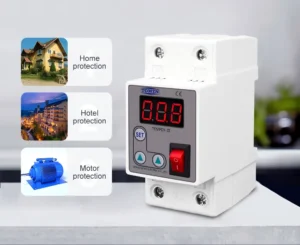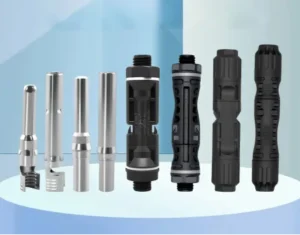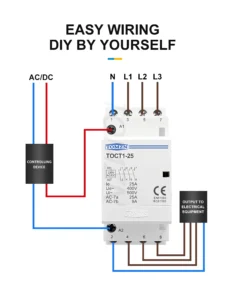

In dealing with high-voltage or complex residential wiring, there is a simple but indispensable component: isolating switch. If you want to maintain electrical safety, knowing how to properly use the isolator switch is the foundation.
Isolating switches have specific functions, which are significantly different from other protection devices such as fuses or circuit breakers. Its main work is to ensure that the circuit is completely powered off for safe service and maintenance.
In this guide, we’ll explore what an isolating switch is, why it’s essential for safety compliance, and how it differs from standard circuit protection.
What is An Isolating Switch?

Isolating switch is a manually operated mechanical switch that is used to isolate part of the circuit from the main power supply. Unlike circuit breakers designed to trip automatically during a fault, such as a short circuit or overload, the isolating switch is designed to be operated manually by technicians.
Core Functions
The isolating switch mainly creates a visible breakpoint in the circuit. When the switch is in the OFF position, it ensures that no current flows to the downstream device. This zero-energy state is essential for the following situations:
- Maintenance: Safely repair the motor, shower or HVAC device.
- Emergency Stop: Quickly cut off power in an industrial environment.
- Testing: Isolate a specific circuit for resistance testing.
TOMZN Tip: Isolating switch is usually an off-load device, which means that unless it is rated as a switch-disconnector, it can ideally only be operated when the current is not flowing.
Isolating Switch & Circuit Breaker: What’s the difference?
Many users often ask: Can I replace the isolating switch with a circuit breaker? Although they look similar, their functions are quite different.
To help you understand the differences, here’s a comparison table for easy scanning:
| Comparison Table of Isolating Switch & Circuit Breaker | ||
| Feature | Isolating Switch | Circuit Breaker |
| Primary Function | Safety isolation for maintenance | Protection against overcurrent/faults |
| Operation | Manual (Human operated) | Automatic (Trips on fault) |
| Load Breaking | Generally Off-load (unless rated otherwise) | On-load (Designed to break live current) |
| Visual Indication | clearly indicates ON/OFF status | Toggle switch (can stick in middle) |
| Application | Before motors, inverters, whole-house mains | Distribution boards, individual circuits |
Although the circuit breaker can cut off the power supply, the isolating switch provides a more reliable and visible disconnection point, which is particularly mandatory for safety regulations (such as NEC or IEC standards) when repairing equipment.
Why Do You Need Isolating Switch?
Integrating the isolating switch into your electrical system is not just to comply with the specification; it is to protect lives.
Facilitates Safety Maintenance (Lockout/Tagout)
The Lockout/Tagout (LOTO) procedure is standard practice in industry. The isolator usually has a padlock facility. This ensures that when the technician works on the machine, others cannot accidentally re-open the switch.
Protect Sensitive Equipment
For devices such as solar inverters or variable-frequency drive (VFD), sudden power outages caused by circuit breakers may cause damage. The isolator allows controlled shutdown procedures to be performed.
Local Isolation
Imagine an air conditioning unit on the roof of a large office building in need of repair. You don’t want to cut off the entire building’s power at the main circuit breaker panel in the basement. The isolating switch installed next to the air conditioning unit allows technicians to cut off only the power supply of the particular unit.

Types of Isolating Switches

Depending on the voltage and application, you may encounter several types:
- Rotary Isolator: The most common type in industrial and commercial environments. It has a large unique turntable (usually red and yellow) that rotates to disconnect the power. They are weatherproof and durable.
- Knife Blade Switch: An older style, common in physics labs or old movies. The copper blade is physically lifted from the contact. Due to the arc risk, these are dangerous for high voltage and are rarely used in modern residential wiring.
- Fused Isolator/Switch Fuse: This combines the isolation function with the fuse. If a fault occurs, the fuse will fuse, but the switch allows you to safely replace the fuse by isolating the casing.
- TP&N (Triple Pole and Neutral): For 3-phase industrial machinery. It ensures that all three phase lines and neutral lines are disconnected at the same time.
How to Install Isolating Switch: Key Considerations
TOMZN Disclaimer: Electrical work is very dangerous. Please be sure to hire certified electricians. The following is a theoretical overview for educational purposes.
When planning the installation of the isolating switch, several factors determine the correct setting:
Voltage and Current Ratings
You must determine the size of the switch according to the load. If you are isolating a 9.5kW electric shower, the standard 20A switch will burn out. You need a 45A or 50A isolating switch.
Environmental Rating (IP Rating)
Is the switch indoors or outdoors?
Indoor: Standard IP20 rating is usually enough.
Outdoor: IP66 rating is required to prevent rain and dust (essential for air conditioning compressors or outdoor lighting).
Wiring Location
The switch should be placed within the sight of the equipment it is isolated from. If the motor is on the roof, the switch must be on the roof, not on the lower three floors. This can prevent the technical personnel from accidentally re-energizing when they are not within sight.

Technical Maintenance of the Isolating Switch
Although the isolating switch is a passive device, it needs to be checked regularly.
Thermal Imaging: In an industrial environment, loose connections inside the isolator can lead to heat accumulation. The thermal imager can find this before the fire.
Mechanical Inspection: Ensure the handle rotates freely. If stiff, it may not be able to completely disconnect the internal contacts.
Sealing Integrity: For outdoor switches, check whether the rubber gasket is intact to prevent water from entering.
Conclusion
Isolating switch provides the necessary gap between the power grid and the maintenance of the power grid. By understanding the difference between isolation and protection and choosing the right ratings for your equipment, you can ensure a safer and more compliant electrical environment.
Whether you’re installing AC units or upgrading your workshop, don’t ignore the importance of high-quality isolators.
For more information on electrical safety standards, please refer to the International Electrotechnical Commission (IEC) guidelines.
Frequently Asked Questions
Can an isolating switch be used as the main switch?
Yes, in many residential user units ( fuse boxes ), the main incoming line switch is usually a switch disconnector that acts as the main isolating switch for the entire property. It allows the homeowner or electrician to cut off all the power of the family through a single action.
What is the difference between isolator and switch disconnector?
Technically, an isolator should be operated only when there is no current flow ( no load ). The switch disconnector is strong enough to turn on and off the circuit even when the current flows ( on load ). However, in general industry terms, these terms are often used interchangeably, but specifications should be checked when purchasing.
Does my shower need an Isolating Switch?
In most jurisdictions ( such as the UK BS 7671 standard ), yes. A local isolating switch is required. It allows the shower to be safely isolated for maintenance or restart without closing the bathroom lights.
Do air conditioning installations use isolating switches?
Yes. For outdoor compressor units of split air conditioners, the standard practice is to install a rain-proof ( IP65 or IP66 ) rotary disconnector ( Rotary Isolating Switch ) near the device. This ensures that HVAC technicians can directly cut off the power supply for maintenance outdoors without entering the building to find the electrical box, avoiding the risk of accidental electric shock caused by poor communication.
How to test whether the isolating switch is faulty?
Never think that the power is off just by pointing the handle to ‘ OFF ‘. Rotate the Isolating Switch to the closing position. Use a Multimeter or a voltage tester to measure terminals on the load side. The reading should be 0V.
If the voltage is still detected after closing, indicating that the internal contacts may have melted and adhered, the switch must be replaced immediately, and the upstream power supply must be cut off before replacement.