
Safety is a primary consideration when building a solar photovoltaic system. Although solar panels and inverters are often the focus of attention, the inconspicuous DC fuse holder plays a key role in preventing catastrophic electrical fires. If you are installing a renewable energy system, knowing how to properly select and install these components is essential.
The DC fuse holder accommodates a specific fuse to interrupt the excessive current in the DC circuit. Unlike standard household AC components, DC protection devices are specifically designed to cope with the persistent arc and high voltage challenges inherent in solar arrays.
What is a DC Fuse Holder?

The DC fuse holder is a special housing unit designed to wrap and protect the DC fuse core. It is usually installed on the DIN rail in the junction box or inverter shell. It mainly provides a touch-safe environment for the fuse, while ensuring a solid electrical connection between the power supply (solar string) and the rest of the system.
But why can’t you use a standard fuse holder directly? The answer lies in electrophysics. When the DC circuit is interrupted ( e.g. when the fuse is fused ), the current will attempt to cross the gap that creates a continuous arc. The dedicated DC fuse holder is made of heat-resistant materials and specific geometric structures, which helps to quickly extinguish this arc and prevent the holder from melting or catching fire.
Key Features of a High-Quality Holder:
- Finger-Safe Design: Prevent accidental contact with live parts during maintenance.
- LED Indicator Light: Many modern holders have indicator lights that light up when the fuse is fused.
- Heat Dissipation: Designed to manage the heat accumulation generated by high-current solar string.

Why Do You Need a DC Fuse Holder for Solar?
Solar panels will generate electricity as long as the sun shines. You can ‘t simply turn off solar panels from the source like a generator. So overcurrent protection is essential. If a short circuit occurs due to wiring damage or component failure, the correct PV special fuse will cut off the connection, isolate the fault and protect the wiring from melting.
The Danger of DC Arc
Direct current (DC) is different from alternating current (AC) that crosses zero 50 or 60 times per second (naturally extinguished arc). DC provides a constant voltage pressure. If there is no DC fuse holder that can suppress this arc, a simple fault may turn into a continuous plasma flame that results in equipment damage or structural fire.
DC VS. AC Fuse Holder: Key Comparison
To help you better understand the need for specialized equipment, the following table highlights the differences between DC and AC protections. This structure is designed to help you quickly verify specifications.
| Comparison Table of DC and AC Fuse Holder | ||
|---|---|---|
| Feature | AC Fuse/Holder | DC Fuse/Holder |
| Current Zero-Crossing | Yes (50/60Hz) | No (Constant Voltage) |
| Arc Quenching | Moderate capability required | High capability required |
| Voltage Rating | typically 240V – 400V | typically 600V – 1500V |
| Physical Size | Often smaller for same amp rating | Larger to allow arc distance |
| Primary Use | Household appliances, grid power | Solar strings, battery banks, EVs |
Warning: Do not use AC fuses or holders in DC solar applications. They are not rated enough to extinguish the DC arc and pose a serious fire risk.
The Role of PV Special Fuse
Although the holder provides a shell, the actual protection comes from the internal fuse core, which is usually called PV special fuse.
PV special fuse is designed for photovoltaic systems according to IEC 60269-6 and other standards. These fuses work differently from standard “slow-break” or “fast-break” fuses. They are designed to trip at relatively low overcurrents (typically only 1.35 to 1.45 times the rated current) due to the limited short-circuit current capacity of solar panels. The standard fuses may never fuse in the event of a solar short circuit that causes wires to overheat. The PV special fuse ensures that the circuit is disconnected before damage occurs.
How to Select the Correct DC Fuse Holder?
Choosing the right equipment involves calculating voltage and current requirements holders on your solar array configuration.
Voltage Rating
The rated voltage of your DC fuse holder must be higher than the open-circuit voltage (Voc) of the solar array and adjusted to the lowest possible temperature.
Example: If your string Voc is 850V, you should choose a holder with a rating of 1000V DC.
Current Rating
The size of the fuse in the holder should usually be determined at 1.56 times of the string short-circuit current (Isc) (1.25 x 1.25 times of the continuous working safety factor required by NEC).
Calculation: If your battery board Isc is 10A – 10A × 1.56 = 15.6A. You should round up to the nearest standard size, possibly a 16A or 20A PV special fuse. The holder must be rated to handle this ampere number.
Connection Type
Most solar DC fuse holders are installed with DIN rails, which is the industry standard for combiner boxes. Ensure that the terminal can accept the American wire gauge (AWG) used in your PV string.
Certification
Always look for a reputable certification. A high-quality DC fuse holder should have UL, TUV or IEC marks.
Installation & Maintenance Best Practices
Proper installation extends the life of your system and ensures that the DC fuse holder works properly when needed.
Torque Correctly: Loose connection will produce resistance that results in heat. Even if the current is within the limit, this heat will melt the fuse holder.
Do not Operate Under Load: Most DC fuse holders are not used as switches. Opening the holder while the current is flowing may pull a dangerous arc. Before replacing the fuse, it is necessary to isolate the circuit through the DC disconnect.
Check Thermal Stress: During annual maintenance, check whether the holder is discolored or deformed. This indicates overheating, possibly due to loose connection or too small holder size.
Keep Spare Parts: Always keep the spare PV special fuse on site. Solar failure usually occurs at the peak of sunshine; having spare parts ensures that you can quickly resume operation after confirming the safety of the system.
The DC Fuse Holder Guards Your Solar System
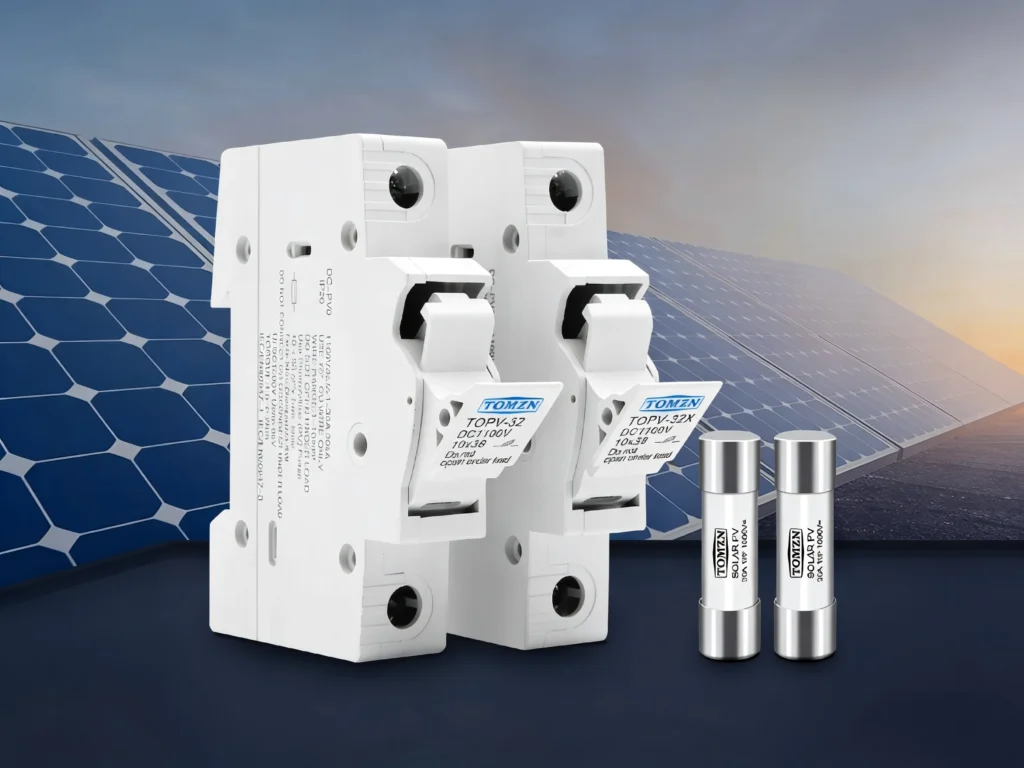
A solar photovoltaic system is a long-term investment that can operate for more than 25 years, and the security of the system often depends on the most inconspicuous components. The DC fuse holder is more than just a simple connection accessory. It is the first line of defense against electrical fires and the protection of expensive inverters and battery panels.
When building or maintaining photovoltaic arrays, it is important to remember that DC and AC are completely different. Do not use mismatched communication components instead. And regularly check your circuit protection device to provide a solid guarantee for your green energy future.
Frequently Asked Questions (FAQ)
What happens if I use an AC fuse holder on DC?
It is dangerous to use the AC holder for DC. The internal contacts and fuses themselves are not designed to extinguish the arc generated when the DC circuit is disconnected. This may lead to melting of the DC fuse holder, continuous arcing, and may cause serious electrical fires.
Where should the DC fuse holder be installed?
It is usually installed in the combiner box (multiple string confluence) or near the inverter input. For maximum safety, it is recommended to install on the positive line of each PV string (for suspended/ungrounded arrays, PV special fuses are usually required on the negative line).
How often should I replace the PV special fuse?
If the fuse is not stressed, it usually does not degrade over time and does not need to be replaced as planned. However, if the fuse is fused, it must be replaced. It is recommended to check the DC fuse holder once a year to see whether there are signs of thermal damage such as discoloration or deformation.
Can I use a circuit breaker instead of a fuse seat?
Yes, you can use a rated DC miniature circuit breaker (MCB). However, fuses usually have a higher interrupting rating, which can more safely cut off high fault current. Many professional installers tend to use DC fuse holders for group cascade protection because they react faster and are more cost-effective in short-circuit conditions.
How to judge whether the fuse has been fused?
There are two main methods of judgment:
Observation indicators: Many modern DC fuse holders are equipped with LED status indicators. When the PV special fuse is fused, the indicator light usually lights up (warning state).
Multimeter test: After disconnecting the power supply and taking out the fuse, use the buzzer or resistance test of the multimeter. If the multimeter does not buzz or display OL (open circuit), it indicates that the fuse has been damaged and needs to be replaced.