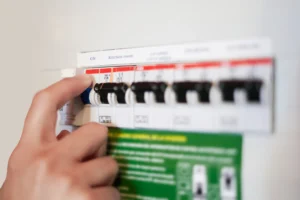
Surge protective device (SPD) is one of the most critical but often overlooked components of any electrical device. Whether you are protecting home smart appliances or the industrial control system of the factory, understanding the function, working principle and required type of SPD may determine whether the equipment can continue to operate stably or cause thousands of dollars of equipment loss.
This guide covers all the key points: what is the surge protective device, the technical principle, the key differences between type 1, type 2 and type 3 SPD, and how to choose the correct surge protection scheme for your application scenario.
What is Surge Protective Device (SPD)?

A surge protective device is an electrical safety component designed to protect equipment, lines, and systems from transient overvoltages – events commonly referred to as voltage surges or voltage spikes. When a surge occurs, the SPD detects excess voltage and safely imports it into the grounding system before it reaches and damages the connected device.
According to the International Electrotechnical Commission (IEC), transient overvoltage is one of the main causes of premature failure of electronic and electrical equipment worldwide, which makes the surge protective device an indispensable investment in any modern electrical device.
Why Need a Surge Protective Device?

The frequency of voltage surge is far more than most people’s cognition. Its sources are divided into two categories: external and internal.
External Sources:
- Lightning strike (direct strike or nearby lightning strike)
- Grid switch utility grid switching
- Power outage and restoration events.
Internal Sources:
- Start-stop operation of large motor and HVAC system HVAC
- Variable Frequency Drives (VFDs)
- Welding equipment and industrial loads
Even low-amplitude micro-surges – small enough to trigger a circuit breaker – will accumulate over time, quietly reducing the performance of semiconductors, capacitors and circuit boards. Eventually it leads to the early end of the equipment life and often can not find a clear cause of the failure.
The reasonably selected surge protective device can provide an invisible but crucial protective barrier for all the above threats.
How does Surge Protective Device Work?
The core working mechanism of a surge protection device is voltage clamping. SPD continuously monitors the line voltage. Once the voltage exceeds the preset safety threshold, the device starts immediately and the excess energy is redirected to the grounding conductor to keep it away from the connected load.
The Role of Metal Oxide Varistor (MOV)
The most commonly used technology inside the surge protection device is the metal oxide Varistor (MOV). Its working process is as follows:
Normal Operation: The voltage is maintained within a safe range. The MOV is in a high impedance state and does not interfere with the normal current flow.
Surge Detected: Transient overvoltage events (such as voltage spikes caused by lightning strikes).
Clamping Activates: MOV impedance drops sharply, providing a low-impedance discharge path to the ground end for surge current.
Energy Diverted: The excess voltage is safely introduced into the grounding electrode grounding electrode, bypassing the connecting device.
Normal Operation Resumes: After the surge dissipates, the MOV restores the high-impedance standby state.
Other technologies used in SPD include:
| Table of SPD’s Technologies | |
|---|---|
| Technology | Best Use Case |
| Metal Oxide Varistor(MOV) | General-purpose,cost-effective |
| Gas Discharge Tube (GDT) | High-voltage, high-energy surges |
| Silicon Avalanche Diode (SAD) | Precision, fast-response electronics |
| Thyristor Surge Protection Device (TSPD) | Telecom and data lines |
Many modern SPDs use a hybrid combination of the above technologies to simultaneously optimize response speed and energy processing capabilities.
Type 1 vs. Type 2 vs. Type 3 SPD: What is the difference?
According to the IEC 61643-11 standard, surge protection devices are divided into different types according to the installation location and the type of surge designed and processed. The most important distinction is type 1, type 2 and type 3 surge protective devices.
| Comparison table of type 1 vs type 2 vs type 3 SPD | |||
|---|---|---|---|
| Feature | Type 1 SPD | Type 2 SPD | Type 3 SPD |
| Installation point | Main service entrance | Distribution/sub-panel | Point of Use |
| Test waveform | 10/350μs | 8/20μs | Combination Wave (1.2/50 μs – 8/20 μs |
| Max impulse current | Up to 100kA+ | Typically 20-40 kA | 1–10 kA |
| Primary threat handled | Direct lightning strike | Switching surges, residual lightning | Residual Transient Voltage |
| Required for LPS? | Yes (IEC 62305) | Not mandatory | No |
What is Type 1 Surge Protective Device?
A type 1 surge protective device (SPD) is a permanently connected, hard-wired device installed on the line side of the main service entrance (before the main breaker) to protect against high-energy, external surges like direct lightning strikes.
Main Features of Type 1 Surge Protective Device:
- It is installed between the public power grid and the main distribution board.
- Can withstand extremely high impulse current impulse current (usually rated up to 100 kA).
- According to IEC 62305, buildings with a lightning protection system (LPS) installed must be equipped with Type 1 SPD.
- Constitutes the first and strongest line of surge protection.
- Protect subordinate equipment and build internal wiring.
What is Type 2 Surge Protective Device?
A type 2 surge protective device (SPD) is a, often modular, component installed on the load side of main electrical service panels or sub-panels to protect sensitive electronics from internal surges caused by switching operations (e.g., motors/appliances cycling) or residual external surges.
Main Features of Type 2 Surge Protective Device:
- Install at the main distribution panel or sub-distribution panel.
- Deal with residual surge and internal transient voltage.
- It is the most widely deployed SPD type in residential and commercial buildings.
- In the absence of type 1 SPD, it is often used as the only protective layer.
What is Type 3 Surge Protective Device?
Type 3 surge protective device is the last line of defense in the surge protection system. It is installed at the point of use, that is, directly near the sensitive equipment that needs protection, such as computer workstations, server cabinets, household appliances, medical equipment or precision instruments.
Its core task is to eliminate the tiny transient voltage after the attenuation of the upstream type 1 and type 2 devices, and to control the voltage that eventually reaches the device port within the safe range that the device can withstand.
Main Features of Type 3 Surge Protective Device:
- Install at the power point terminal, next to the protected equipment.
- The nominal discharge current is usually low, ranging from 1 to 10 kA.
- It must be used in conjunction with the upstream type 1 or type 2 SPD, and cannot be used as the only independent protective measure.
Where should the Surge Protective Device be Installed?
To achieve comprehensive surge protection, the Tomzn team recommends a coordinated multi-level protection strategy:
- Level 1 – Inlet Service Entrance: Type 1 SPD intercepts large external surges before they enter the building.
- Level 2 – Distribution Panel: Type 2 SPD attenuates residual surge and internal transient voltage.
- Level 3 – Power Point of Use: Type 3 SPD (Plug-in surge protector or socket surge protector) provides the last line of defense in sensitive terminal equipment such as computers, televisions, and medical equipment.
- Each Protection Level Decreases Surge Energy in Turn: This strategy is sometimes referred to as cascaded surge protection. No matter how high the rated value is, a single device cannot provide complete protection.
How to Select the Appropriate Surge Protective Device?
In the selection or purchase of SPD, please focus on the following parameters:
- SPD Type: Determine whether type 1, type 2 or type 1 + 2 combination device is needed according to the installation position.
- Voltage Protection Rating (Up/VPR): The maximum voltage of SPD terminal during surge. The lower the value, the better. For a 230V system, Up ≤ 1.5kV is the ideal value.
- Nominal discharge current (In): SPD can withstand the current level repeatedly without reducing the performance.
- Maximum continuous operating voltage (Uc): Must be equal to or greater than the system supply voltage.
- Standard Compliance: Always verify whether the device has passed the relevant standard certification in the region.
How to Install Surge Protective Device Safely?
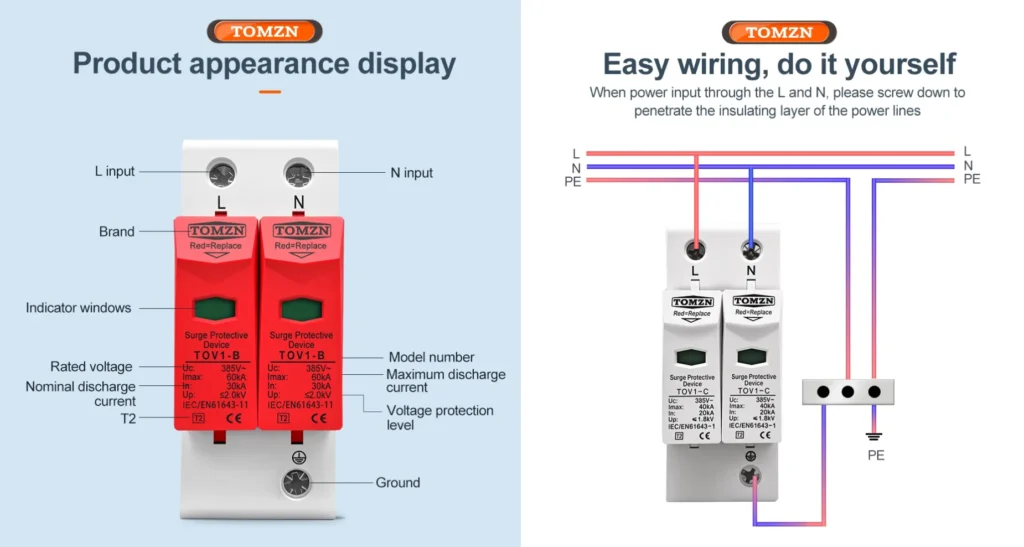
Proper installation of surge protective devices is as important as choosing the right product. Improperly installed SPD may not only fail to protect your equipment, but also pose a security risk. Please follow the following steps for safe and effective installation.
Close the main power supply
Before any operation, the main circuit breaker is first disconnected to ensure that the switchboard is completely powered off. Do not install SPD on a live electrical system. After using a non-contact stylus to confirm that there is no voltage, continue the follow-up operation.
Wear the necessary personal protective equipment (PPE)
Insulation gloves and protective glasses must be worn during installation. Even after the main circuit breaker is closed, some components may still have residual power. Taking basic safety protection measures can effectively reduce the risk of electric shock or arc flashover.
Select the correct installation location
Install SPD as close as possible to the main distribution panel or protected equipment. The shorter the lead between the SPD and the switchboard, the smaller the line impedance, and the better the protection performance of the equipment.
Correctly connect the line
Operate in strict accordance with the wiring diagram provided by the manufacturer, and use the wire that meets the specifications to correctly connect the SPD lead to the corresponding terminals: live wire(L), neutral wire(N) and ground wire. The lead should be as short and straight as possible and it is recommended not to exceed 0.5 meters to reduce the voltage drop when the surge occurs. Avoid sharp bends or winding of the wire.
Fix the equipment and close the switchboard
After completing all wiring, the SPD shell is firmly installed on the switchboard or the mounting surface. Check whether all the terminals are tightened, close the cover plate of the distribution panel after confirming that it is correct, and then restore the power supply.
Restore power supply and verify the running state
Close the main circuit breaker and check the status indicator of SPD. Most modern surge protectors are equipped with LED indicator lights or window-style status displays to visually determine whether the device is working properly. The indicator light is green, usually indicating that the SPD is in a normal working state and can provide protection at any time.
If in doubt, please consult a certified electrical engineer
Although the installation operation of some SPDs is relatively simple, there is a big risk in the internal operation of the switchboard. If you are not confident in your own electrical professional knowledge, please be sure to entrust a qualified certified electrical engineer to install. This is particularly important for Type 1 SPDs installed at the main power supply. Such installations must conform to local electrical specifications, such as the NEC (National Electrical Code) in the United States.
Safety tips : Please be sure to read the installation manual provided by the SPD manufacturer carefully before installation, and ensure that the installation process conforms to all applicable local electrical specifications and standards, such as IEC 61643-11 or UL 1449.
Final Thought about Surge Protective Device

In an era of voltage-sensitive electronic devices, interconnected systems and power quality fluctuations, surge protective devices are no longer optional. From protecting household appliances to guarding millions of dollars worth of industrial automation systems, a reasonable selection of SPDs can bring reassurance and long-term economic benefits.
Whether your project needs to install type 1 surge protective device at the incoming end, type 2 surge protective device at the switchboard, or deploy a complete multi-level coordinated surge protection strategy, it is one of the smartest investments you can make in the field of electrical safety to choose a device that passes the certification and has the correct rated parameters.
For further information, please read our related articles:
Protect Your HVAC System with an AC Surge Protection Device
PV Surge Protection Device – Everything You Should Know
Can surge protective devices completely protect against direct lightning strikes?
Any SPD cannot provide 100 % protection against direct lightning strikes. However, the Type 1 surge protective device – combined with a complete Lightning Protection System (LPS) compliant with IEC 62305 – with the correct rated selection of the Type I surge protective device can significantly reduce the risk of equipment damage and fire.
How long is the service life of SPD?
Each surge event will cause a certain degree of loss to the MOV component inside the device. Most high-quality SPDs are equipped with a status indicator light or observation window, which will turn red or fail when the device needs to be replaced. The expected service life is usually 5 to 10 years, depending on the frequency and strength of the surge.
Is the surge protective device and SPD the same kind of product?
Not exactly the same. Plug-in surge protective device belongs to type III SPD Type 3 SPD, which only provides local power point protection. It cannot replace the hard-wired type I or type II surge protective device surge protective device installed on the switchboard. The most robust protection effect can be achieved by using the three-level superimposed layered protection scheme.
Do solar energy and electric vehicle charging devices require SPD?
Yes. Photovoltaic (PV) systems and electric vehicle (EV) charging equipment are particularly sensitive to surge damage. IEC 61643-32 specifically provides for SPD selection of photovoltaic systems. When selecting surge protection for renewable energy devices, please be sure to consult a certified electrical engineer.