
Every home relies on a circuit breaker to ensure the safe operation of the electrical system. However, most homeowners hardly pay attention to the circuit breaker before it goes wrong. Until the lights suddenly go out, an electrical appliance stops working, or the electrical panel starts buzzing. Whether you ‘re dealing with a tripped circuit breaker, a faulty electrical panel, or planning to replace the entire breaker box, this guide will take you through everything from the basic principles to the actual operation.
What is a Circuit Breaker?

A circuit breaker is a safety protection device installed in the electrical panel. When it detects a dangerous fault (such as overload or short circuit), it will automatically cut off the current. Fuses must be replaced after fusing, and circuit breakers unlike fuse can be reset manually and used repeatedly.
Each modern home is equipped with a breaker box, in which several independent breakers are installed. Each circuit breaker controls a specific circuit in your home – a bedroom, kitchen appliances, HVAC system, etc.
How Does a Circuit Breaker Work?
Each circuit breaker contains a bimetal strip and an electromagnet. The working process is as follows:
Normal operation: the current flows from the distribution box to each circuit through the circuit breaker, and the bimetallic strip and electromagnet are in a stable state.
Overload is detected: When the current passing through a circuit is too large (for example, too many devices are connected to the same circuit), the bimetal is heated and expanded and bent, triggering the circuit breaker to trip mechanically and switch to the off position.
Detection of short circuit: the large current generated at the moment of short circuit makes the electromagnet form a strong magnetic field, and the circuit is forced to be disconnected in milliseconds to protect the line and avoid fire.
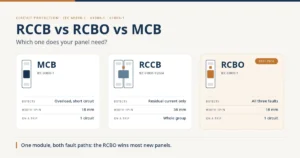
Ground fault protection (GFCI circuit breaker): The circuit breaker continuously detects the current difference between the fire line and the zero line. If the difference exceeds about 5 mA, it indicates that part of the current flows to the earth through the human body or other unexpected paths, and the circuit breaker will immediately trip.This automatic response mechanism makes the circuit breaker the most critical safety component in the distribution box. According to the Electrical Safety Foundation International (ESFI), there are about 51,000 household electrical fires in the United States every year, and the normal operation of circuit breakers is the primary measure to prevent such fires.
Why Does the Circuit Breaker Trip Repeatedly?
Frequent tripping indicates that there are potential problems. Common causes include:
- Circuit overload: A single circuit is connected to too many high-power devices.
- Short circuit: Somewhere in the line, the live wire is in direct contact with the neutral wire.
- Grounding fault: Current accidentally flows to the earth through an off-design path.
- Circuit breaker aging: The internal components of circuit breakers that have been used for more than 25-30 years may be aging, resulting in false tripping when the current does not reach the rated value, or failure to disconnect normally when overload occurs.
- Electrical failure: A single faulty electrical appliance may cause the circuit to continue to trip.
Note: If the circuit breaker trips again immediately after the closing reset, the repeated operation should be stopped and the certificated electrician should be contacted for inspection.
How to Test a Circuit Breaker?
When checking electrical problems, multimeters are an essential tool for homeowners and electricians. Using the multimeter to verify the circuit breaker needs to prepare the following tools:
- Digital multimeter: to AC voltage (VAC), the range is usually 120V or 240V.
- Insulated handle screwdriver
- Non-contact stylus (recommended to improve operational safety)

How to Test a Circuit Breaker with a Multimeter?
Safety preparation: Put on rubber shoes and wear insulating gloves. Inform the co-resident that you will check the distribution box.
Open the panel cover of the distribution box: remove the screw on the panel door and open it carefully. Do not touch the main bus bars or the large cross-section incoming wire introduced from the external meter. Even if the main breaker has been turned off, these parts are still in a charged state.
Set the multimeter: dial the knob to the AC voltage range (VAC), select 200V or higher.
Test the terminal voltage of the circuit breaker: the red probe is contacted with the screw terminal of the circuit breaker, and the black probe is contacted with the neutral bus bar (silver copper bar with white wire).
- The normal 120V circuit breaker reading should be between 115V-125V.
- The normal 240V double-pole breaker reading should be between 230V-250V.
- If the circuit breaker is in the on state but the reading is 0V, it indicates that the circuit breaker has failed and needs to be replaced.
Test the output voltage: in the state of the circuit breaker ON, go to the outlet of the circuit or the lamp for measurement. If the distribution box end reading is normal (120V), but the socket end reading is 0V, the fault is on the line wiring, rather than the circuit breaker itself.

Record the test results: record all the circuit breaker numbers with low or zero voltage, so as to communicate accurately with the electrician.
For more in-depth references, please refer to Fluke Corporation’s multimeter guide, which covers the best operating specifications for AC/DC measurements.
How to Reset a Circuit Breaker?
Resetting the tripped circuit breaker is the most common operation encountered by residents. After tripping, the circuit breaker handle is usually located in the middle position between ON and OFF. When reset, the handle is first pulled to the OFF position by hand, and then pushed back to the ON position, without any tools.
- Find the circuit breaker that has been tripped in the electrical panel, and the switch is biased to the middle position or is already in the OFF position.
- Disconnect or close all electrical equipment on the circuit to reduce the load.
- First, push the circuit breaker switch hard to the fully OFF position, you will feel a clicking sound.
- Then push the switch to the fully ON position, you will hear the second click.
- If the circuit breaker trips again immediately, please stop the operation and contact the electrician.
Safety tips: If the circuit breaker cannot be kept in the on state, do not repeatedly operate the reset. Continuous tripping means that there is a serious fault, which must be diagnosed by professionals.
How to Replace a Circuit Breaker?

Replacing a bad circuit breaker involves turning off the main power, removing the panel cover, and replacing the faulty unit with an identical brand/amperage. Essential safety steps include using a voltage tester to ensure the power is off, wearing rubber-soled shoes, and properly securing wire connections. If you are unfamiliar with electrical panels, hire a licensed electrician to avoid risks of electrocution or fire.
Here are the detailed steps to install the new circuit breaker:
- Adjust the direction of the new circuit breaker to make the connection screw terminal face the outside.
- The circuit breaker is jammed into the bus bar: the buckle on the back of the circuit breaker is pressed into the stab connector on the bus bar until the clicking sound is heard.
- Insert the wire into the terminal of the new circuit breaker and tighten the screw according to the specified torque (usually 20-35 inches·pounds, please refer to the product specification table/spec sheet/of the circuit breaker).
- Reinstall the panel cover of the box and tighten all screws.
- Reconnect the main breaker and dial the new breaker to the ON position.
- Test the circuit: measure the voltage with a multimeter, or verify whether the power supply is normal by turning on the electrical equipment.
When Do I Need to Replace the Whole Electrical Breaker Box?
Sometimes it is not enough to replace only a single circuit breaker. If the following situations occur, it may be necessary to replace the electrical breaker box as a whole:
- The service life of the distribution box is more than 30-40 years.
- The distribution box brand belongs to the recalled model.
- A new loop is needed, but there are no open slots in the distribution box.
- Residential power supply capacity needs to be upgraded from 100 A to 200 A service.
- The distribution box shows signs of corrosion, charring or water moisture.
- It is necessary to install EV charger, solar system or whole-home generator.
More Related article about circuit breaker:
Miniature Circuit Breaker (MCB) Complete Guide: Types, Safety & How To Choose
FAQ
Can I replace a circuit breaker myself or should I hire an electrician?
Whether you can replace a circuit breaker yourself depends on your local laws, the type of electrical panel you have, and your personal experience with electrical systems. While physically swapping a breaker is relatively straightforward, working inside an electrical panel involves exposure to live components that carry enough current to be fatal.
How to change a circuit breaker?
Replacing a circuit breaker involves turning off the main power, removing the panel cover, disconnecting the wire, rocking out the old breaker, and snapping in a new, compatible breaker. Safety is paramount: always use a voltage tester to ensure the panel is de-energized, as hot wires may still exist. The job usually takes 15–30 minutes.
How much are breakers?
Circuit breakers typically cost between $5 and $250+, with standard single-pole breakers (15-40 amp) costing around $5–$30 and specialized or high-amperage breakers costing more. Common, top-rated residential 20-amp breakers from brands like Square D or Eaton generally cost between $6 and $15, while AFCI/GFCI or specialized breakers can exceed $50–$60 per unit.
How to tell if a circuit breaker is bad?
A bad circuit breaker often shows signs like tripping immediately after being reset, a burning smell, visible scorch marks, or a “mushy” switch that won’t stay in the ‘on’ position.
Why does my circuit breaker keep tripping?
A breaker usually keeps tripping because of an overloaded circuit, a short circuit, or a ground fault. Overloads occur when too many appliances operate at once; short circuits happen when wires touch; and ground faults are caused by moisture or damaged wiring. If it trips instantly, it is likely a short or ground fault, which is dangerous.