
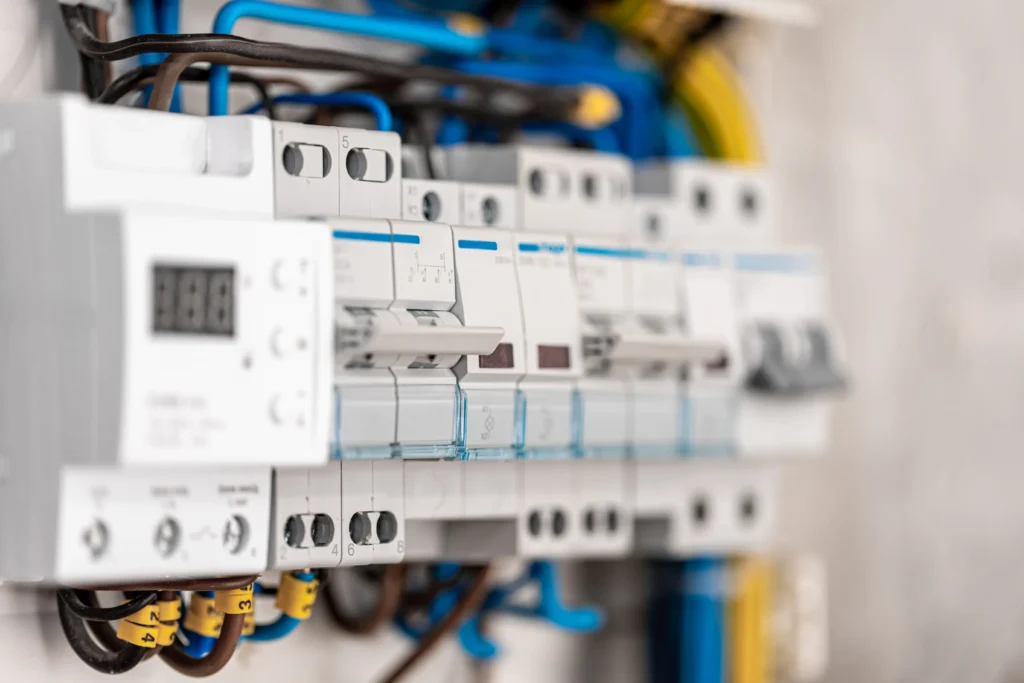
Behind every circuit trip and every unexpected power outage, it points to the same core question: is your electrical protection system really reliable?
Miniature circuit breakers (MCB) and electrical protection devices constitute the first line of defense for electrical safety in modern buildings. Among them, miniature circuit breaker (MCB) has become the most widely used overcurrent protection device in residential, commercial and industrial distribution boxes (electrical panels) due to its characteristics of automatic tripping, reset and compact size.
However, MCB alone is not enough to deal with all electrical risks. In the backup power scenario, manual transfer switch (MTS) and MCB work together to build a complete security system from power switching to loop protection.
This guide will introduce the working principle, type selection and cooperation with manual transfer switches of MCB, as well as the safety points that cannot be ignored in actual installation – to help you make correct and safe decisions for electrical devices of any size.
What Is a MCB Miniature Circuit Breaker?
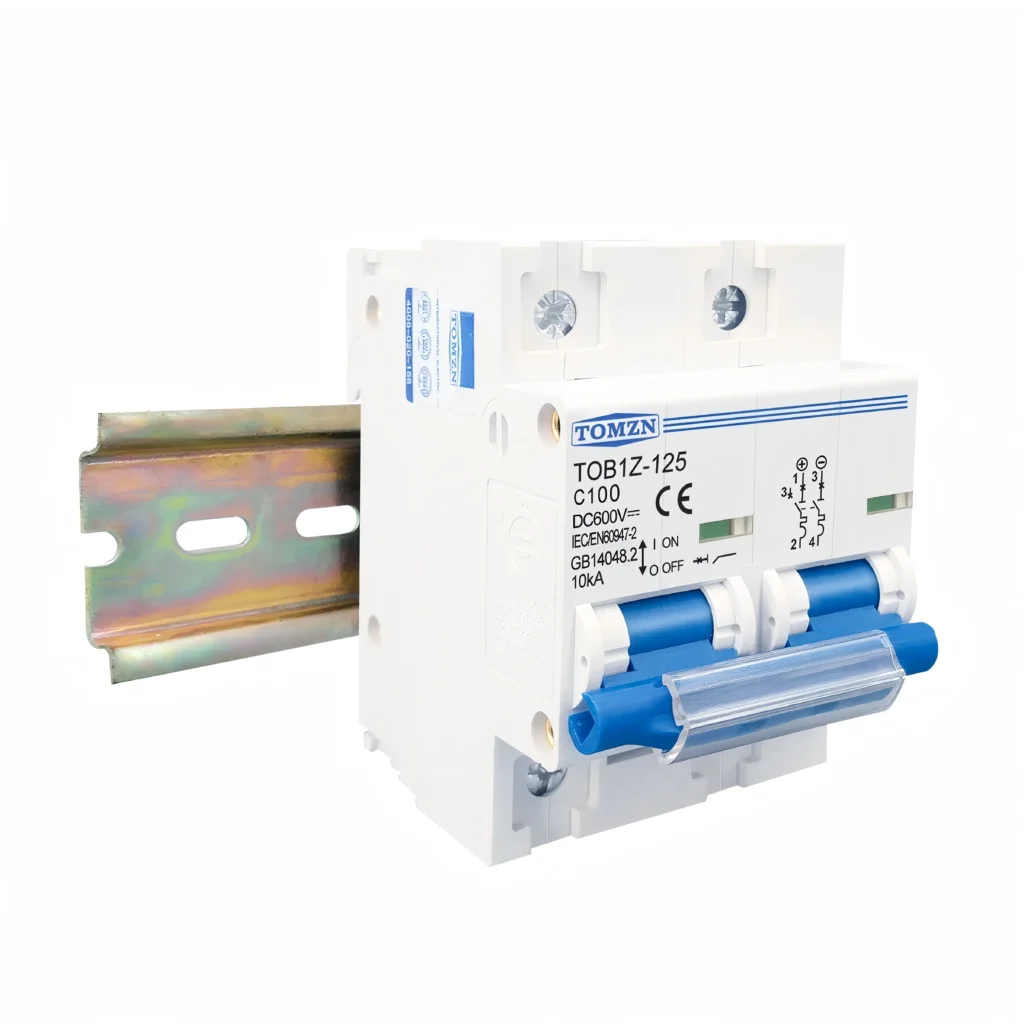
A miniature circuit breaker (MCB) is an automatically operated electrical switch designed to protect the circuit from damage caused by overcurrent, overload or short circuit. Different from the traditional fuse that must be physically replaced after each fault, MCB only needs to be simply reset after tripping, so it is a more practical, economical and safe solution in modern electrical systems.
Functions of the MCB:
- Automatically cuts off the circuit when a short circuit or overload occurs.
- Protect cables, appliances and equipment from sustained overcurrent damage.
- Provide convenient manual ON/OFF switching function.
- Fast fault isolation and easy reset can be achieved after a trip event.
Major mini circuit breaker (MCB) manufacturers include global giants like ABB, Schneider Electric, Siemens, Eaton and Tomzn, alongside specialized brands such as PhoenixContact, Hager, and Square D, with many others like BCH Electric and Panasonic also prominent, offering thermal-magnetic protection for <100A applications in residential, commercial, and industrial settings.
How Does a Miniature Circuit Breaker Work?
The miniature circuit breaker deals with two different types of electrical faults through two independent protection mechanisms.
Thermal protection: dealing with overload
Each MCB is equipped with a bimetallic strip. When the current exceeds the rated value, the bimetallic sheet will be heated and bent. When the bending degree reaches the set threshold, the tripping mechanism will be triggered and the circuit will be cut off. This mechanism is used to protect the cable and the connected equipment from thermal damage caused by continuous overcurrent.
Magnetic protection: dealing with short circuits
When a short circuit occurs, the current will rise sharply in a very short time. The electromagnetic coil inside the MCB generates a strong enough magnetic field to trigger a trip in milliseconds – its response speed is much faster than any fuse. This near-instantaneous response is critical to prevent fires and equipment damage.
It is this dual-action protection mechanism that makes miniature circuit breakers the preferred alternative to fuses in almost all modern electrical panel designs.
MCB vs. Fuse: Why Miniature Circuit Breakers are Better?
| MCB and fuse comparison table | ||
|---|---|---|
| Feature | Miniature Circuit Breaker(MCB) | Traditional Fuse |
| Resettable after fault | Yes – simply reset | No – must be replaced |
| Short-circuit response speed | Milliseconds (magnetic trip) | Moderate |
| Visual trip indicator | Clear trip position | Limited |
| Reusability | Reusable for life of device | Single-use only |
| Long-term cost | Lower | Higher |
| Safe isolation capability | Yes | No |
| Current rating flexibility | Wide range | Limited options |
From each practical indicator, the miniature circuit breaker is superior to the traditional fuse, especially in terms of safety, convenience and total cost of ownership throughout the life cycle of the device.
When might a fuse still be preferred?
Although miniature circuit breakers (MCB) have completely replaced traditional fuses in most modern electrical installations, fuses still have irreplaceable advantages in the following specific scenarios.
Ultra-high breaking capacity requirements
When the expected short-circuit current at the installation point is extremely high, such as the secondary side of a large industrial transformer, the breaking capacity of some dedicated high breaking capacity fuses (HRC fuses) can reach 80-100kA or even higher, far exceeding the breaking limit of the same volume MCB (usually 10-25kA). In such scenarios, HRC fuse is a safer and more economical choice.
Extreme environment and high reliability
The fuse is a fully sealed pure electrical component without mechanical mechanism, which is more reliable in the following environments:
- Strong vibration environment (such as ships, rail transit vehicles)
- Extreme high temperature or low temperature situations (beyond the rated operating temperature range of MCB)
- Precision instrument protection circuits that are highly sensitive to electromagnetic interference (EMI)
The MCB contains mechanical components such as bimetallic strips and electromagnetic coils, and there is a risk of mechanical fatigue in a strong vibration environment for a long time, while the fuse has no such concern.
Cost-sensitive large-scale low-voltage distribution
In simple branch circuits that require a large number of protection points and have a very low failure frequency, such as large agricultural irrigation facilities or temporary electrical installations, the initial acquisition cost of disposable fuses is much lower than that of MCB, which can significantly reduce the overall cost when the number of total circuits is large.
Precise protection of semiconductor equipment
The response time of common MCB is limited by mechanical action, usually in the range of 8-20ms. The fuse time of semiconductor fuse/ultra-fast fuse can be as low as 1ms, which can complete the protection before the MCB has not been operated, so as to avoid the damage of IGBT, SCR and other power semiconductor devices due to short-circuit current.
Types of MCB Circuit Breaker
Not all MCBs are the same. The correct type depends entirely on the characteristics of your electrical load, especially the magnitude of the inrush current generated by the load at the moment of startup.
| MCB Type Table | |||
|---|---|---|---|
| MCB Type | Trip Range (x Rated Current) | Best For | Typical Application |
| Type B | 3-5x | Resistiveloads | Residential lighting, sockets |
| Type C | 5-10x | Inductive loads | Motors, fluorescent lighting |
| Type D | 10-20x | High inrush loads | Transformers, welding equipment |
| Type K | 8-12x | Motor protection | Industrial motor circuits |
| Type Z | 2-3x | Sensitive electronics | Semiconductor devices |
Type B and type C miniature circuit breakers are the most common specifications in residential and commercial electrical panels. The error selection will lead to two adverse consequences: too sensitive will cause nuisance tripping and insufficient protection will not be effectively protected. There are security risks in both cases.
How Do Miniature Circuit Breakers and Manual Transfer Switches Work Together to Protect Your Circuits?
The miniature circuit breaker and the manual transfer switch act on two different levels of your electrical system to form a complete set of protection strategies.
What is a manual transfer switch (MTS)?
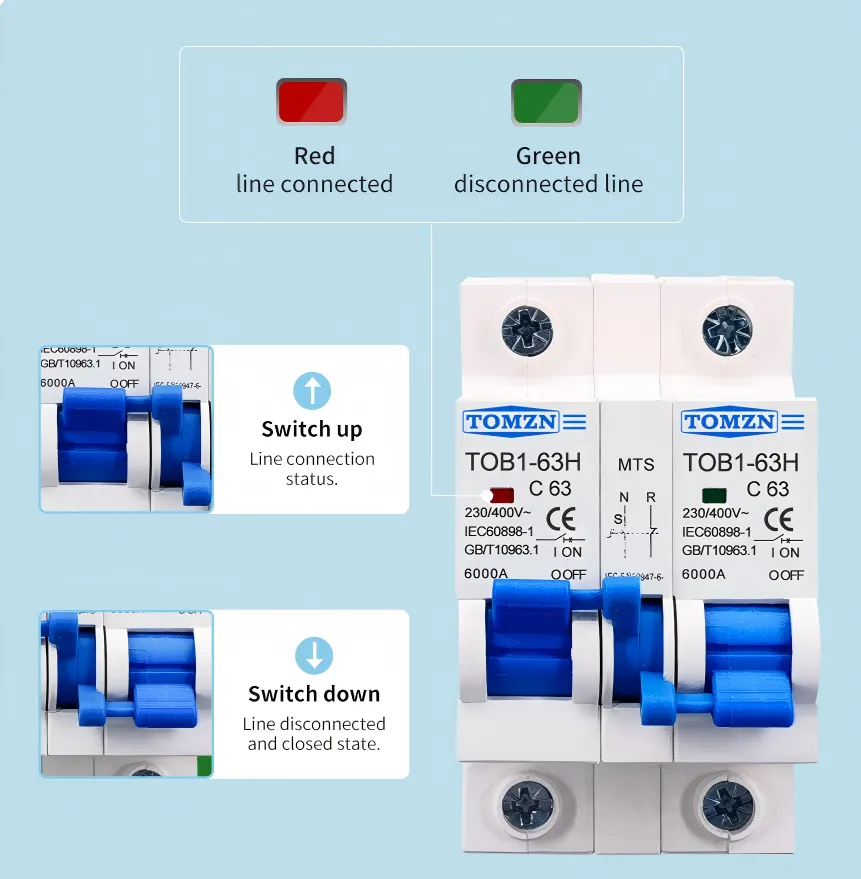
The manual transfer switch (MTS) allows the operator to manually switch the electrical load between the utility supply (main power supply) and the backup generator or the second power supply. It is the basic component of any backup power system that prioritizes safety, reliability and compliance with specifications.
Unlike automatic transfer switch (ATS), which is a device that automatically completes power switching without manual intervention after detecting a power outage, manual transfer switch needs to be operated by the operator. Although the response speed is slightly slower, the MTS structure is simpler, the cost is lower and it is extremely reliable for residential and small commercial backup power systems.
Benefits of installing a manual transfer switch:
- Securely isolate utility power before connecting to the generator.
- Prevent dangerous and potentially fatal power feedback (back-feed) back into the public grid.
- Most of the national electrical regulations in the vast majority of areas require installation.
- Provides a clear, operator-controlled operating sequence for power switching.
- Compared with the automation scheme, it is more cost-effective for small devices.
Power changeover workflow
The manual transfer switch manages the source of the power supply and determines whether the power supply to the electrical panel is the utility power or the generator power. The miniature circuit breaker in the electrical panel manages how the power is distributed and protected in each circuit.
- Utility power interruption
- Operators cut off non-essential loads to reduce the generator starting load.
- Start the generator until it reaches a stable operating voltage and frequency.
- The operator manually operates the manual transfer switch to connect to the generator power supply.
- The miniature circuit breaker in the electrical panel implements overload and fault protection for each circuit.
- After the utility power is restored and stabilized, the operator cuts back the utility power through MTS and shuts down the generator.
5 Critical Safety Considerations for MCBs and Manual Transfer Switches
The rated current of MCB must match the current-carrying capacity of the cable
Do not install a miniature circuit breaker whose rated current is higher than the current carrying capacity of the protected cable. Oversizing the MCB is one of the most common and dangerous errors in amateur electrical construction, which will completely invalidate the circuit protection.
Regularly check MCB every six months

A miniature circuit breaker that has not been operated for a long time may not trip when needed due to the stuck internal mechanism. Please press the test button on each MCB every six months to confirm the normal operation of the mechanism. This is particularly important for those circuits that rarely carry large currents.
Before resetting the tripping MCB, the reason must be found out first
If miniature circuit breaker trips, do not reset directly without finding the cause. Repeated tripping of the same circuit is a clear warning signal, indicating that there are potential faults – such as damaged electrical appliances, aging cables or wiring errors – that must be diagnosed and troubleshooting before re-transmission.
Follow the correct operating sequence when using Manual Transfer Switches
Before switching, the load should be reduced first. Unless the equipment is clearly rated to support on-load switching, do not operate the manual transfer switch under full load. Please operate in strict accordance with the switching sequence specified by the manufacturer to avoid damage to the transfer switch and the connected equipment.
All installation work must be undertaken by a licensed electrician
The installation of miniature circuit breaker and manual transfer switch should be completed by a qualified licensed electrician in strict accordance with the local electrical code. Improper installation may lead to failure of equipment warranty, invalid building insurance, and failure to pass inspection. More importantly, it may cause life-threatening safety hazards.
How Do I Choose the Right Miniature Circuit Breaker for My Electrical Panel?
Choosing the right miniature circuit breaker (MCB) requires matching its technical specifications—such as current rating, trip curve, and breaking capacity—to your circuit’s load and wiring. For North American panels, it is often critical to use the same brand and series as your panel to ensure physical and electrical compatibility.
The parameters need to be checked when purchasing:
- Rated current (In): Must not exceed the current-carrying capacity of the protected cable.
- Breaking capacity (Icn): Must be equal to or greater than the expected short-circuit current at the prospective short-circuit current.
- Trip curve: B/C/D/K/Z type, to be matched with load type – resistive, inductive or motor.
- Number of poles: Single-pole for single-phase branch circuit; double or triple-pole is used in the case of multiphase or need to cut off the neutral line.
- Voltage rating: Must be compatible with system voltage (e.g. 120V, 230V, 400V).
- Standards compliance: Find IEC 60898-1 or UL 489 certification marks, depending on the region.
Protect Your Circuits with the Miniature Circuit Breaker (MCB)
Miniature circuit breaker is an intelligent and resettable safety mechanism that can protect your electrical circuit from two of the most destructive electrical faults: sustained overload and instantaneous short circuit. When the MCB is used in conjunction with a properly installed manual transfer switch, your electrical infrastructure will receive a layered, dual-reliable protection covering the power supply end and the circuit end.
Understanding MCB and how it works with manual transfer switches will help you design, standardize, and maintain safe, compliant and durable electrical systems. Whether you are upgrading your electrical panel or selecting the specifications for commercial facilities, if you need help, please check here to the official website of Tomzn.
FAQ
What is the difference between MCB and MCCB?
The rated current upper limit of miniature circuit breaker (MCB) is 125 A, which is suitable for residential and light commercial low current branch circuits. Molded Case Circuit Breaker (MCCB) can withstand higher current, usually up to 2,500 A, for industrial and large commercial power distribution systems.
Can I install a manual transfer switch by myself?
In most countries and regions, installing a transfer switch must be completed by a qualified electrician and can be put into use after passing the relevant tests. Self-installation not only has security risks, but also may violate local electrical specifications and even affect the effectiveness of insurance clauses.
How long is the service life of the miniature circuit breaker (MCB)?
Under normal operating conditions, high-quality miniature circuit breakers can normally operate stably for 20 to 30 years. However, any MCB that has been used to cut off a large fault current should be inspected and considered for replacement, as its internal components may have been damaged or degraded.
Does the miniature circuit breaker (MCB) have waterproofing?
The standard miniature circuit breaker (MCB) itself does not have a protection level certification for wet or outdoor environments. If it is required to be used outdoors or in a humid environment, the MCB must be installed in a protective enclosure that meets the corresponding IP level. Before installation, please make sure that the IP level of the selected shell can meet the requirements of the actual installation environment.
Can a miniature circuit breaker (MCB) be used as a disconnect switch?
Yes, one of the practical advantages of MCB over fuses is its ability to act as a safety isolation device, allowing the circuit power to be manually disconnected during maintenance or troubleshooting.