Under the background of the continuous change of electricity bills and the increasing awareness of environmental protection, understanding electricity consumption has become the basic demand of modern society, and the energy meter is the core tool to achieve this goal. Whether it is the owner who wants to reduce the cost of household electricity, or the manager who is responsible for the operation of large industrial facilities, the energy meter is the basic equipment for monitoring, managing and optimizing the use of electricity.
This blog aims to introduce the key information about the energy meter. The content covers basic functions, working principles and compares the different types suitable for different scenarios to help readers understand how to improve the efficiency and controllability of power use through appropriate monitoring tools.
What is an Energy Meter?

An energy meter is a kind of equipment used to measure the amount of electric energy consumed by residential, enterprise or power consumption equipment. Electric power companies use these devices installed in customer premises for billing and monitoring. They are usually calibrated in billing units, the most common being kWh. Therefore, you will often hear the industry professionals call the standard residential meter kWh energy meter.
Benefits of Using Energy Meters:
- Accurate Billing: Ensure that you only pay for the amount of electricity you actually consume.
- Electricity Insight: Help you identify electrical appliances with large power consumption, so as to adjust your electricity consumption habits.
- Power Grid Stability: Enable power companies to understand the peak period of electricity consumption and effectively allocate power.
How does the Energy Meter Work?
Consumers often ask: How does the energy meter convert the invisible power into a readable number?
An energy meter relies on measuring two very different electrical values: voltage (electrical pressure) and current (electrical flow).
Electromechanical Energy Meter: In the traditional energy meter, the voltage and current will produce a magnetic field, thus rotating a small aluminum disk. The rotation speed of the aluminum plate is proportional to the power passing through the meter. A series of gears transforms this rotation into a reading dial that you see on the panel.
Digital Energy Meter: Modern digital energy meter does not rely on mobile components. Instead, they use highly sensitive alternating current (AC) sensors to detect voltage and current. The microchip processes these analog signals and converts them into digital data. This precise digital sampling provides incredibly accurate power consumption readings, which are then displayed on the LCD screen.
How to Read an Energy Meter?
For many first-time users of power management, it can be confusing to see rows of bouncing numbers or rotating dials on the device. So, how to read the energy meter? The correct reading method mainly depends on whether you are using a traditional mechanical energy meter or a modern digital energy meter.
Read the Modern Digital/Smart Energy Meter

The vast majority of modern kWh energy meters or digital displays are equipped with clear LCD screens.
Direct Reading: The number displayed on the energy meter display represents the total amount of electricity consumed in units of kilowatt hours (kWh). When reading, the integer part is read from left to right. If the number area has different colors (usually red) or decimal points after the number, these represent less than 1 kilowatt hours of the part, in the conventional meter reading can be ignored.
Cycle Display: Some advanced energy meters have a rolling display function, which automatically displays different parameters (such as total power consumption, current voltage, current, etc.). Please wait patiently. When an interface with a kWh unit appears on the screen, write down the number.
Read the Traditional Mechanical Energy Meter
This traditional energy meter usually has 4 to 5 dials like a small clock, which requires a little skill when reading:
- Read from Left to Right: Record the number pointed by each dial pointer in turn.
- Pointer between Two Numbers: If the pointer stops between two numbers, always record the smaller number.
Note: If the pointer is between 9 and 0, it is denoted as 9, because here 0 represents 10.
Pay Attention to the Direction of Rotation: Carefully observe the scale on the dial, adjacent dial pointer rotation direction is usually the opposite (one is clockwise, the next is counterclockwise).
TOMZN suggests that the electric energy meter shows the cumulative total power consumption since installation. To calculate your actual power consumption for a specific period of time, such as a month, simply subtract the current reading from the reading recorded on the same day of the previous month.
Common Types of Energy Meter

When selecting an energy meter, you must match the device to your power system. The two most common electrical systems determine whether you need a single phase energy meter or a three phase energy meter.
Single-Phase Energy Meter vs. Three-Phase Energy Meter
| Comparison Table of Single-Phase Energy Meter & Three-Phase Energy Meter | ||
|---|---|---|
| Feature | Single Phase Energy Meter | Three Phase Energy Meter |
| Typical Use Case | Residential homes, small apartments, and small offices. | Large commercial buildings, industrial factories, and data centers. |
| Wiring Structure | Requires two wires: one phase (live) and one neutral. | Requires four wires: three phases (live) and one neutral. |
| Voltage Level | Usually operates around 120V to 230V (depending on the country). | Operates at much higher voltages, typically 400V to 415V. |
| Power Capacity | Suited for standard appliances (lights, TVs, standard fridges). | Suited for heavy loads (large HVAC systems, heavy industrial motors). |
| Reliability of Supply | If the single phase fails, the power is entirely cut off. | If one phase fails, the other two can often continue providing power. |
Din Rail KWH Watt Hour Energy Meter
With the improvement of the degree of refinement of energy management, the normal energy meter has been unable to meet the diverse monitoring needs. The DIN rail watt hour energy meter has been developed for more detailed power metering scenarios.
The DIN rail watt hour energy meter adopts a modular design and can be installed on a standard 35 mm wide DIN-rail. The rail is common in the distribution box and is used to fix electrical equipment such as circuit breakers. This kind of energy meter can directly use the existing guide rail in the distribution box, which is especially suitable for the scene where the space is compact or the measurement circuit needs to be increased or decreased in the later stage.
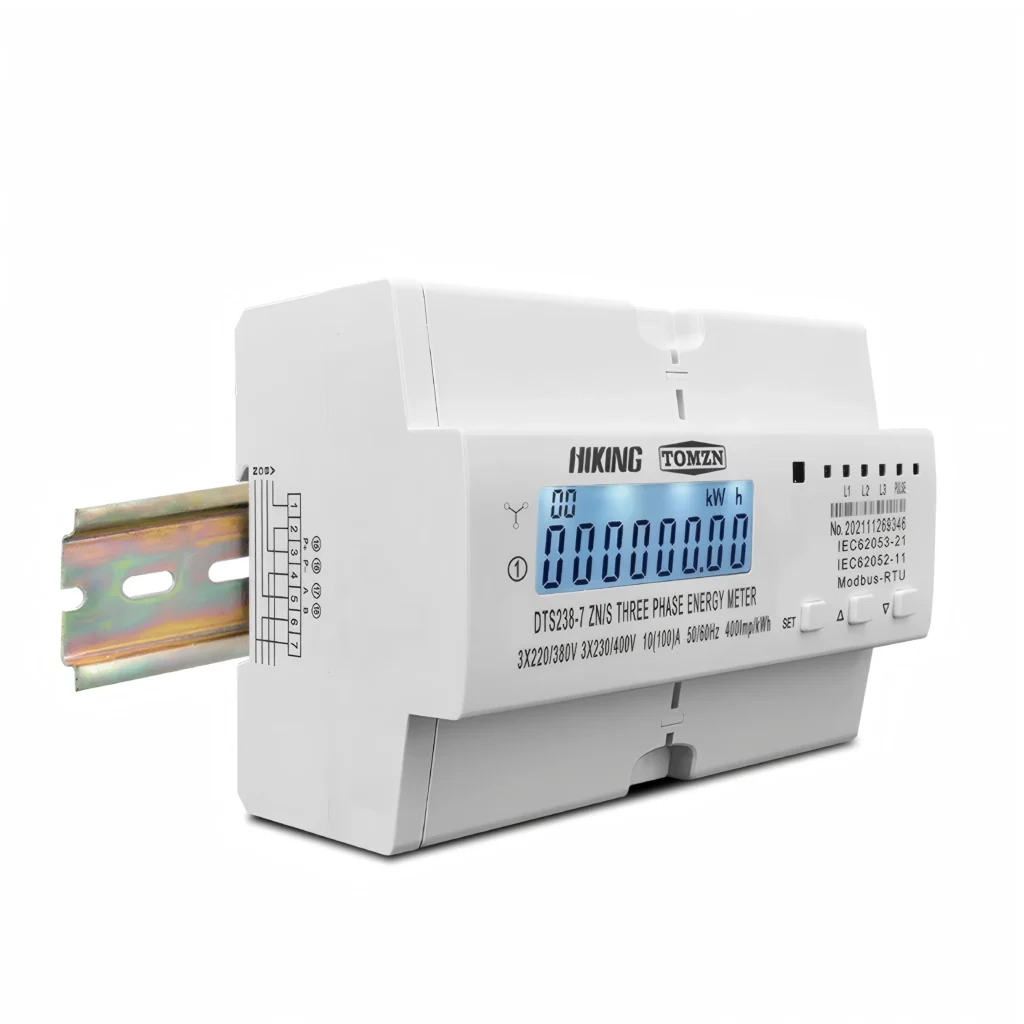
Benefits of DIN Rail Watt Hour Energy Meter:
- Sub-Metering: Independent monitoring can be carried out for specific circuits, such as electric vehicle charging piles, heat pumps or independent rooms, to achieve electricity consumption statistics for a single load or area.
- Easy Installation: The standardized guide rail installation method simplifies the wiring layout in the distribution box without additional brackets.
- Data Integration: Many models are equipped with Modbus or Wi-Fi communication protocols, which can transmit power data to energy management systems or automation platforms in real time for centralized monitoring and analysis.

The Evolution of Intelligent Power Monitoring of Energy Meter
We bid farewell to the era of manually reading the energy meter number with a flashlight. Nowadays, smart energy monitoring represents the cutting-edge technology in the field of power tracking. Smart meters can carry out two-way communication; they send electricity data to the power company for accurate billing, and simultaneously send real-time data to the consumer’s smartphone application.
Advantages of Intelligent Monitoring:
- Avoiding Estimated Bills: Smart energy meters can automatically upload accurate electricity data. Power companies issue bills based on actual usage, and users no longer need to bear the high cost based on estimated usage.
- Time-of-Use Electricity Price Optimization: users can run high-power equipment such as washing machines during off-peak hours with low electricity prices based on real-time electricity price information provided by smart meters, thereby reducing electricity costs.
- Support Solar Energy Integration: For users who install solar panels, smart energy meters with two-way metering function can record the amount of electricity taken from the grid and the remaining amount of electricity transmitted to the grid, providing a basis for the measurement of residual electricity.
How to Choose the Best Energy Meter?
Whether you’re upgrading an old facility or building a new smart home, keep the following factors in mind when choosing hardware:
- Determine Your Phase: Check your main circuit breaker – Do you need a single-phase energy meter or a heavy-duty three-phase energy meter?
- Clear Purpose of Use: Are you used to charging tenants for electricity? If yes, please find a certified kWh energy meter that meets the local statutory measurement standards. Do you just want to track the power consumption of a particular appliance? A plug-in power monitor or rail-type watt-hour meter is enough.
- Check Network Connectivity: If you want to integrate your energy meter with a smart home ecosystem such as Home Assistant, Alexa, or Google Home, make sure your meter supports Wi-Fi, Zigbee, or Z-Wave protocols.
- Verify the Accuracy Level: Look for a meter with a 1.0 or 0.5 accuracy level to ensure that the reading is highly accurate.

Conclusion
Understanding electricity consumption is the basis for achieving sustainable development and controlling electricity costs. From the traditional energy meter installed on the external wall of the house to the guide rail type electric energy meter installed in the distribution box, all kinds of equipment can provide specific power consumption data.
With the help of modern power monitoring technology, users can grasp the power consumption of each period and region according to real-time information, and then identify high energy consumption links and optimize power consumption behavior.
Frequently Asked Questions (FAQs)
Can I install my own energy meter?
Although the plug-in power monitor is absolutely safe for anyone to operate, the main panel or sub-panel energy meter must be installed by a licensed electrician. Dealing with the main distribution panel involves deadly voltage, requires professional qualifications and knowledge, and does not disassemble.
What does the flashing red light on the energy meter represent?
Most modern digital kWh energy meters have a red LED indicator. Each flicker represents that you consume a certain amount of electrical energy (for example, some models consume 1 kWh per 1000 flickers). The faster the red light flashes, the greater the amount of electricity you currently consume. If the red light is often on and does not flash, it usually means that there is no current power consumption.
Does the energy meter itself consume electricity?
Yes, but this part of the power is minimal. Most modern digital meters only consume less than 1 to 2 watts of power to maintain the normal operation of their internal electronic devices, sensors and digital displays. This part of the minimal power consumption is usually borne by the power company and will not be included in your bill.
What is the difference between smart energy meters and ordinary energy meters?
Ordinary energy meters only display your total electricity consumption on the screen or dial, requiring manual meter reading. Smart energy meters will actively record power consumption at intervals (usually every 15 to 30 minutes) and transmit these data to consumers and utility providers through wireless networks, thus truly realizing automated intelligent power monitoring.
How long is the service life of the energy meter, and needs to be replaced regularly?
The design service life of modern solid-state electronic energy meters is usually 15 to 20 years. However, over time, extreme weather, aging of internal components or electrical surges may affect its accuracy. If you find an unexplained abnormal surge in electricity bills, you can contact your power company for accuracy testing, or request to be replaced with an updated smart device.